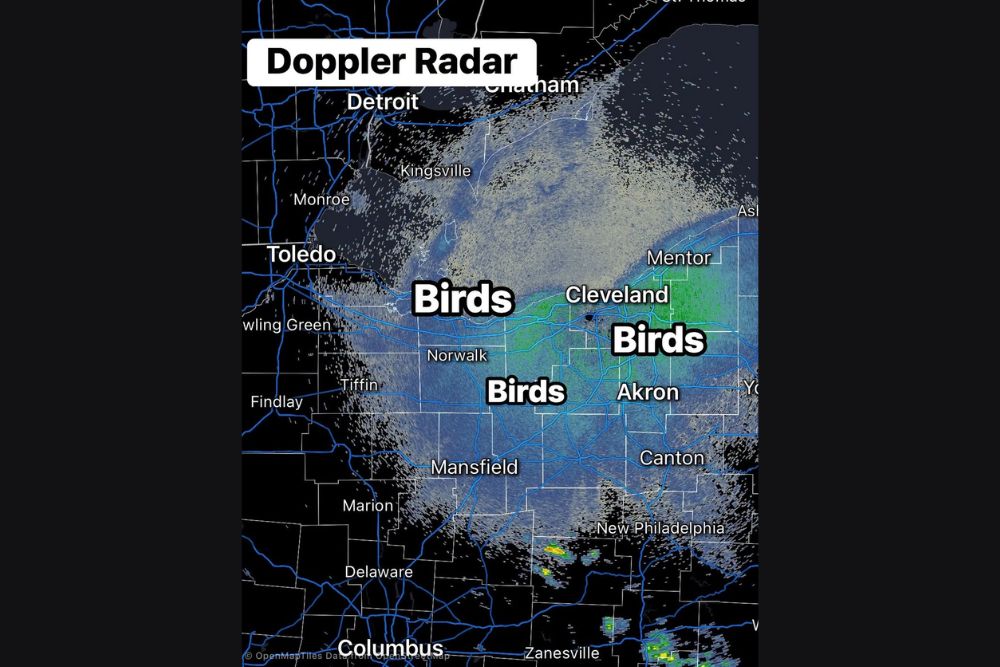
CLEVELAND, OH — A massive nocturnal bird migration lit up NEXRAD Doppler Radar across Ohio Friday night, with the movement so heavy that it was initially mistaken for moderate precipitation, as data from BirdCast estimates more than 8 million birds were in flight over the state at the height of the event.
Radar Mistakes Birds for Rain
Radar imagery captured at 8:38 PM, updated at 8:41 PM, showed a massive, sweeping arc of returns stretching from the Detroit and Toledo areas across northern Ohio through Cleveland, Akron, and Canton, continuing south toward Mansfield and Columbus. At first glance, the pattern resembled a widespread area of light to moderate rainfall, but meteorologists identified the signature as biological activity rather than precipitation, with the radar display specifically labeling large portions of the return as “Birds” across the Norwalk, Cleveland, and Akron areas.
A Nationwide Migration of Staggering Scale
The Ohio bird surge is part of a far larger continental event, with BirdCast estimating that over 400 million birds are migrating south across the country at an average altitude of roughly 2,300 feet. That altitude places the migrating flocks squarely within the range where Doppler radar systems are most effective at detecting and tracking airborne biological activity, allowing meteorologists to capture such a clear and expansive picture of the migration as it moved across Ohio overnight.
The sheer number of birds involved, both the 8 million estimated over Ohio specifically and the 400 million migrating nationwide, underscores the scale of the seasonal movement currently underway as species make their way south ahead of the changing season, using nighttime hours to travel when cooler temperatures and calmer winds typically make for safer and more efficient flight conditions.
How Meteorologists Tell Birds From Rain
Doppler radar works by sending out pulses of energy and analyzing what bounces back, a process that can detect not only raindrops and snow but also other airborne objects, including birds and insects, a category meteorologists refer to as biological activity. Distinguishing between actual precipitation and biological targets requires careful analysis of the radar data’s characteristics, including the shape, movement pattern, and timing of the returns, since large-scale bird migrations often appear as expanding rings or arcs on radar that behave differently from how rain typically moves and develops.
The nocturnal timing of Friday’s migration event over Ohio is itself a telling clue, since many migratory bird species specifically choose to travel after dark, taking advantage of calmer atmospheric conditions and using stars and the Earth’s magnetic field for navigation, a behavior pattern well documented by ornithologists studying these seasonal movements.
Why This Matters Beyond a Curious Radar Image
Beyond serving as a striking visual on weather radar, large-scale migration events like this one carry real significance for understanding broader patterns in bird populations and movement timing. BirdCast’s ability to estimate migration volume using radar data has become an increasingly valuable tool for researchers and conservationists tracking how migratory patterns shift from year to year, along with providing practical information for reducing hazards to migrating birds, such as encouraging reduced nighttime lighting in urban areas during peak migration periods.
Ohio’s position along a significant north-south migratory corridor makes it a common location for these kinds of large detected movements, particularly during the late summer and early fall period when many species begin their southward journey toward wintering grounds.
What Ohio Residents Witnessed Overnight
For anyone who happened to be outside Friday night across the affected parts of Ohio, the passage of millions of birds overhead would have been largely invisible to the naked eye given the high altitude and nighttime timing of the migration, even as the radar picture captured the event in striking detail. The scale of the movement serves as a reminder of the enormous, largely unseen biological activity that regularly passes overhead during peak migration season each year.
For continuing coverage of severe weather events and critical storm analysis across the United States, visit svhsnow.com.