INDIANAPOLIS, IN — Bald eagles are flourishing once again across Indiana, marking one of the state’s great wildlife recovery success stories as confirmed nesting territories have surged from a mere handful in the early 1990s to well over 350 today, according to data from the Indiana Department of Natural Resources.
A Species Pushed to the Brink
Bald eagles were once heavily endangered within Indiana during the 1970s, a period marked by rapidly declining populations, significant habitat loss, and severe reproductive setbacks caused primarily by the pesticide DDT. That chemical, widely used in agriculture at the time, caused eagle eggshells to thin dramatically, leading to widespread nest failures and a population collapse that threatened the species’ continued presence in the state entirely.
The severity of the decline meant that by the time conservation efforts began in earnest, Indiana had gone decades without a single successful bald eagle nest, a stark illustration of just how close the species had come to disappearing from the state altogether before dedicated recovery programs began turning the tide.
A Reintroduction Program Takes Root
Between 1985 and 1989, wildlife officials released 73 bald eagle chicks at Monroe Lake as part of a concentrated reintroduction effort aimed at reestablishing a breeding population within the state. That investment paid off in dramatic fashion in 1991, when Indiana recorded its first successful bald eagle nest in decades at both Monroe Lake and Cagles Mill Lake, representing the first successful nesting recorded in the state since the late 1800s according to DNR records.
That milestone marked a genuine turning point for the species within Indiana, proving that the reintroduced eagles were not only surviving but successfully reproducing and establishing the kind of stable breeding territories necessary for long-term population recovery across the state.
From Five Territories to Hundreds
The scale of the recovery becomes especially clear when comparing the earliest data to today’s numbers. In 1991, Indiana had just five confirmed nesting territories established across the entire state, a fragile foothold for a species working its way back from the edge of local extinction. Fast forward to the present, and that number has grown to more than 350 confirmed nesting territories, representing a staggering seventy-fold increase in just over three decades.
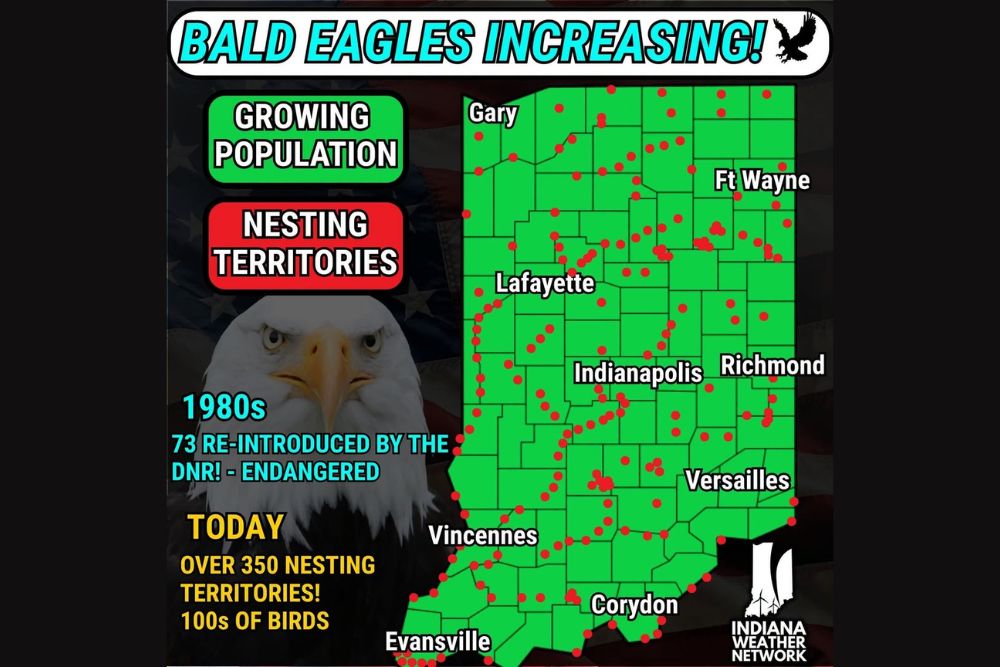
Mapped data illustrating this growth shows red markers representing individual nesting territories scattered densely across nearly every region of the state, from the northern reaches near Gary and Fort Wayne down through Lafayette, Indianapolis, and Richmond, continuing south toward Vincennes, Corydon, and Evansville. The sheer density and geographic spread of these markers underscores just how thoroughly bald eagles have reestablished themselves across virtually the entire state rather than remaining confined to a small handful of original recovery sites.
The Map Likely Understates Today’s Numbers
Officials cautioned that the mapped nesting territory data reflects figures from 2020, meaning the true current number of nests and nesting areas across Indiana is likely even higher than what appears on the map. Given the consistent upward trajectory the population has shown over the past three decades, it stands to reason that continued growth since 2020 has added still more nesting territories beyond those already documented, making the true scope of the recovery potentially even more impressive than the available data suggests.
Why This Recovery Matters
The bald eagle’s turnaround in Indiana mirrors a broader national recovery story that followed the banning of DDT in the early 1970s, a policy change credited with allowing eagle populations to rebound across much of the United States. Indiana’s specific numbers, however, stand out for the sheer scale of the growth, transforming from a state with essentially no successful nesting activity to one hosting hundreds of established territories and, based on the population trends, likely hundreds of individual birds across its diverse landscape of lakes, rivers, and forested areas.
Where to Learn More
Residents interested in learning more about bald eagles in Indiana, including updated nesting data and ongoing conservation efforts, are encouraged to visit the Indiana Department of Natural Resources for additional information and resources related to the state’s remarkable raptor recovery story.
For continuing coverage of severe weather events and critical storm analysis across the United States, visit svhsnow.com.