WILMINGTON, NC — Significant flash flooding overtook the Wilmington metro area Saturday evening, submerging roadways and neighborhood streets across the region as heavy rainfall overwhelmed drainage systems, prompting officials and forecasters to issue the familiar but critical warning to motorists: turn around, don’t drown.
Roadways Turn Into Rivers Across the Metro
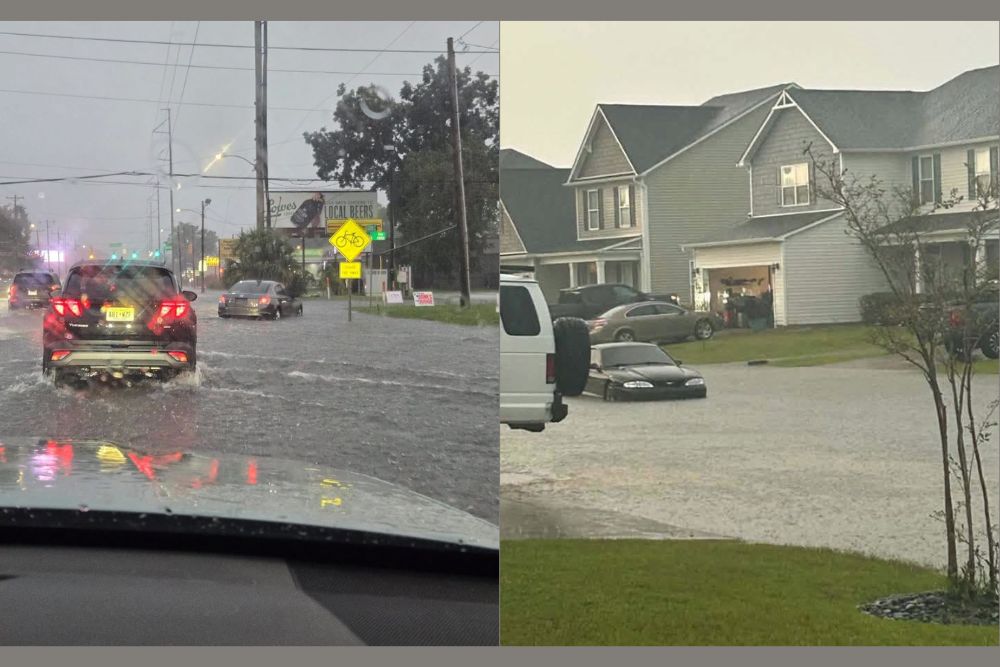
Photographs shared from across the affected area captured the severity of the flooding as it unfolded. One image showed vehicles navigating a completely submerged roadway, with water rising high enough to reach vehicle bumpers and reflect the glow of taillights and a nearby illuminated business sign along what would normally be a standard commercial corridor. The depth and extent of the water across the roadway illustrated just how quickly the evening’s rainfall overwhelmed the area’s drainage capacity, transforming a typical street into a hazardous, flooded corridor in a short span of time.
A second photograph captured flooding within a residential neighborhood, showing a flooded street with standing water extending across the roadway and lawns, with vehicles parked in driveways surrounded by rising water. The residential flooding depicted in the image demonstrates how this event extended well beyond just major roads, reaching into neighborhood streets and potentially threatening homes and property throughout affected communities across the Wilmington area.
Why Flash Flooding Develops So Quickly
Flash flooding of this nature typically develops when intense rainfall falls at a rate faster than the ground and drainage infrastructure can absorb or channel it away, causing water to pool and rise rapidly on roadways and in low-lying areas. Coastal communities like Wilmington can be particularly susceptible to this kind of rapid-onset flooding, given the combination of flat terrain, high water tables, and drainage systems that can become quickly overwhelmed during periods of intense, sustained rainfall.
The submerged conditions visible in both photographs reflect a scenario where water depth on roadways became difficult to accurately judge from a vehicle, one of the most dangerous aspects of flash flooding since even seemingly shallow water can conceal deeper sections, washed-out pavement, or swift currents capable of sweeping a vehicle off the road.
The Critical Message: Turn Around, Don’t Drown
The phrase “turn around, don’t drown” has become a standard and widely recognized safety message from the National Weather Service, specifically crafted to address the fact that a significant portion of flood-related fatalities occur when people attempt to drive through flooded roadways. Just a foot or two of moving water can be enough to sweep a vehicle off the road, and floodwater often conceals the true depth and condition of the pavement beneath it, making it impossible for drivers to accurately assess the danger before it is too late.
This guidance applies regardless of how familiar a driver may be with a particular road or how capable their vehicle seems, since flash flood conditions can change the nature of a roadway dramatically and unpredictably compared to normal, dry conditions.
Residential Areas Face Their Own Set of Risks
Beyond the dangers posed to motorists, the flooding captured in residential neighborhoods across the Wilmington metro raises additional concerns for homeowners, including the potential for water intrusion into garages, ground-floor living spaces, and vehicles parked at properties throughout the affected area. Standing water around homes can also create secondary hazards, including electrical dangers if flooding reaches outdoor outlets or ground-level electrical panels, along with the more gradual risk of water damage to structures and belongings.
What Residents Should Do as Flooding Continues
With significant flash flooding actively impacting the Wilmington metro area, residents throughout the region are strongly urged to avoid unnecessary travel until conditions improve and water levels recede. Anyone who encounters a flooded roadway should follow the standard safety guidance and find an alternate route rather than attempting to drive through standing water, regardless of how passable it might appear from a distance.
Homeowners in low-lying or flood-prone areas should also monitor conditions closely at their properties, taking precautions to protect vehicles and belongings where possible while avoiding unnecessary exposure to floodwaters that may carry contaminants, debris, or hidden hazards beneath the surface.
Looking Ahead for the Wilmington Area
As the evening’s heavy rainfall continues to work through the region, local officials and meteorologists will be closely monitoring for any additional flooding concerns, including the potential for water levels to continue rising in low-lying areas even after the heaviest rain has moved through. Residents are encouraged to stay updated through local weather and emergency management channels as the situation continues to develop across the Wilmington metro area.
For continuing coverage of severe weather events and critical storm analysis across the United States, visit svhsnow.com.