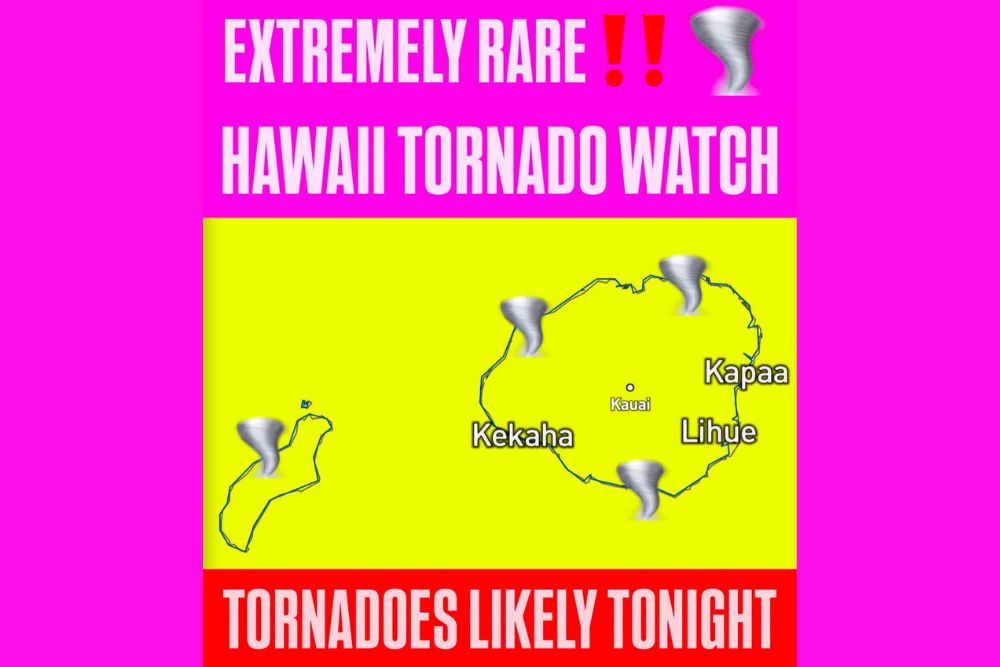
LIHUE, HI — An extremely rare Tornado Watch has been issued for Kauai County, including Lihue and the surrounding coastal waters, remaining in effect until 4 AM HST Tuesday as Hurricane Lowell tracks dangerously close to the island chain. The National Weather Service confirmed that atmospheric conditions favorable for tornadoes and waterspouts are developing across Kauai as the powerful hurricane passes nearby, prompting officials to urge residents and visitors to remain weather-aware and prepared to move quickly to a sturdy interior room if a Tornado Warning is issued.
Hurricane Lowell’s Track Raises Tornado Threat Across Kauai
Hurricane Lowell has tracked north on a path bringing it close to Kauai and Niihau, with the National Weather Service warning that several tornadoes are possible near the islands through Monday night into early Tuesday. The setup is considered unusual for Hawaii, where tornado watches are issued far less frequently than in mainland states, making this an especially notable weather event for island residents.
Southerly winds on the eastern side of Lowell’s counterclockwise circulation are pushing warm, humid air over the islands, a pattern that meteorologists say increases the likelihood of the fast-spinning, short-lived tornadoes and waterspouts associated with landfalling or near-passing tropical systems. Communities including Kapaa, Lihue, and Kekaha all fall within the watch area outlined for Kauai County.
Storm Intensity and Broader Impacts to the Island Chain
Hurricane Lowell has fluctuated between Category 2 and Category 3 intensity as it approaches the Hawaiian Islands, with maximum sustained winds reported near 110 to 115 mph at various points during its approach. Kauai and Niihau have been placed under both a Hurricane Warning and a Tropical Storm Warning, reflecting the increased risk of both damaging winds and tornado-producing rain bands as the storm’s core passes to the west of the islands.
Beyond the tornado threat, forecasters have warned of storm surge of two to four feet along Kauai’s south coast, life-threatening surf, and flash flooding driven by heavy rain bands wrapping around the hurricane’s circulation. The combination of hazards has led Hawaii’s governor to declare a state of emergency for the state, activating National Guard resources ahead of the storm’s closest approach.
What a Tornado Watch Means for Kauai Residents
Officials reiterated the distinction between weather alert levels as the watch remains active: a Tornado Watch means conditions are favorable for tornado development, while a Tornado Warning means a tornado has actually been detected or indicated on radar, requiring immediate shelter. Residents across the watch area were advised to keep emergency alerts enabled overnight and to identify a safe, interior room away from windows in case conditions escalate.
Shelters across Kauai opened over the weekend in anticipation of Lowell’s arrival, and county officials closed parks, campgrounds, schools, and government offices on Kauai and Niihau as the hurricane’s effects intensified. The tornado threat adds another layer of urgency to preparations already underway across the island for wind, surge, and flooding impacts.
Timeline for the Overnight Threat
The Tornado Watch remains in effect until 4 AM HST Tuesday, spanning the period when Hurricane Lowell is expected to make its closest approach to Kauai before turning north-northwest and slowing down later Tuesday. Forecasters noted that the tornado and waterspout threat is expected to persist through the overnight hours as outer rain bands continue rotating onshore ahead of the storm’s center.
Residents across the watch area were encouraged to treat the overnight period as the most critical window for monitoring conditions, given how quickly short-lived tornadoes can form and dissipate within tropical rain bands. As Lowell continues its track past the islands, additional advisories are expected as the situation evolves through Tuesday morning.
For continuing coverage of severe weather events and critical storm analysis across the United States, visit svhsnow.com.