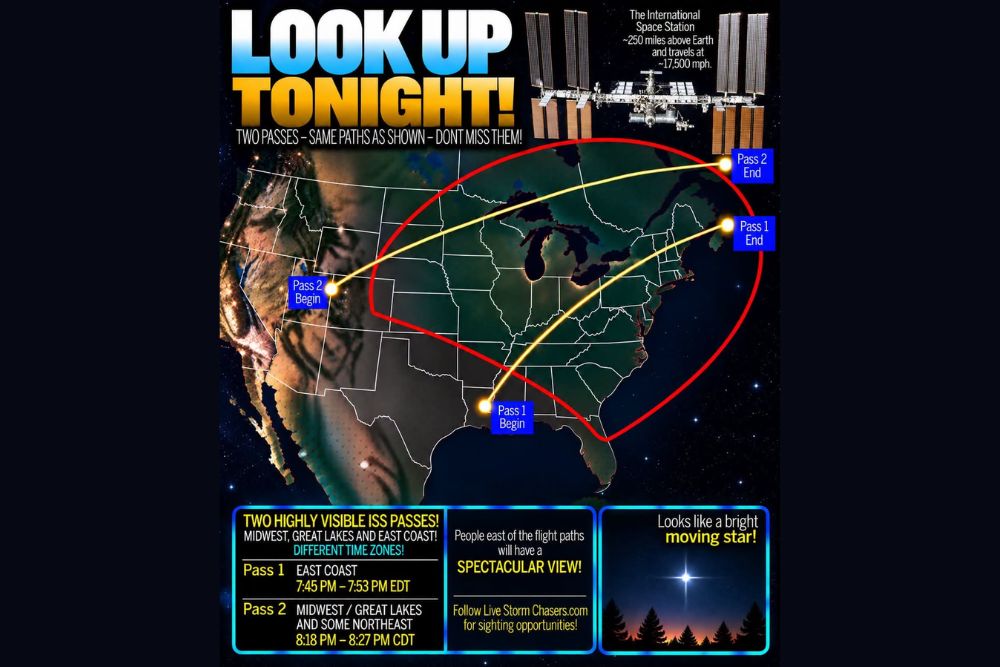
MINNEAPOLIS, MN — Skywatchers across a wide swath of the country have a chance to catch two highly visible passes of the International Space Station tonight, with the first pass over the East Coast already concluded and a second, highly favorable pass beginning around 8:18 PM CDT across the Midwest, Great Lakes, and into the Northeast. The station currently carries seven crew members, with NASA astronaut Jessica Meir among those aboard as it orbits roughly 250 miles above Earth at approximately 17,500 miles per hour.
Pass One Over the East Coast Has Already Concluded
The first of tonight’s two ISS passes was visible along the East Coast, with a viewing window running from approximately 7:45 PM to 7:53 PM EDT. That pass has already concluded by the time the second, more widely visible pass begins across the central and northern portions of the country, meaning residents along the East Coast who missed the earlier window will need to wait for another opportunity on a future night.
Tracking data shows this first pass beginning near the Gulf Coast and arcing northeastward across the eastern United States before concluding off the Atlantic coast, a path that placed much of the East Coast within range of a viewing opportunity earlier in the evening.
Second Pass Begins at 8:18 PM Across the Midwest
The second and more prominently highlighted pass begins around 8:18 PM CDT, with favorable viewing extending across portions of Nebraska, Iowa, Minnesota, the Great Lakes region, and continuing into the Northeast. This pass follows a track that carries the station from the western Great Plains diagonally across the northern Midwest and toward the Northeast, offering an extended viewing corridor for residents across multiple states.
Tracking data shows this second pass beginning in the western Great Plains region and arcing northeastward across Minnesota, the Great Lakes, and into the Northeast, concluding somewhere off the northeastern coast as the station continues its orbital path away from the continental United States.
Minneapolis Positioned for a Nearly Direct Overhead Pass
Among the many communities within tonight’s viewing corridor, Minneapolis stands out as a location where the station will fly almost directly overhead during the second pass, offering what should be an especially prominent and easy-to-spot viewing opportunity for residents in that area. A nearly overhead pass typically provides the brightest and most dramatic viewing experience, since the station is at its closest approach to observers directly beneath its orbital path.
Residents elsewhere within the broader viewing zone should still have a good chance to spot the station, though those farther from the direct flight path will see it appear lower in their sky compared to the more dramatic overhead view expected for those closer to Minneapolis.
Overlap Zones Offer a Chance to Catch Both Passes
Some areas around the Great Lakes, Northeast, and East Coast fall within the overlap zone for both of tonight’s passes, meaning residents in those specific locations could potentially catch both viewing opportunities if timing and sky conditions cooperate. For those positioned inside the broader highlighted viewing region but outside the direct overlap zone, there remains a chance to catch one or the other of tonight’s two passes.
This overlap reflects the complex geometry of the station’s orbital path, which crosses different sections of the continental United States at different times during the same overall observing window on a single night.
What to Expect When Looking Up
The International Space Station will appear to observers as a bright, steady-moving object crossing the sky, distinguishable from aircraft by its lack of blinking lights and its notably swift, smooth motion. Given the station’s altitude of roughly 250 miles and its orbital speed of about 17,500 miles per hour, a visible pass typically lasts only a few minutes from horizon to horizon.
Observers are encouraged to simply step outside for about 10 minutes around their local viewing window and look toward the sky in the general direction indicated by tracking data, since the station’s brightness and steady movement make it relatively easy to identify once it comes into view.
A Crew of Seven Currently Aboard
As of tonight, there are seven crew members currently living and working aboard the International Space Station, including NASA astronaut Jessica Meir, contributing to the ongoing scientific research and station operations that continue uninterrupted as part of the orbiting laboratory’s long-running mission. Each visible pass offers the public a direct, tangible connection to that ongoing human presence in low Earth orbit.
What Residents Should Do Tonight
Residents across the Midwest, Great Lakes, and Northeast who want to catch tonight’s second ISS pass should head outside a few minutes before 8:18 PM CDT and look toward the sky, with those near Minneapolis positioned for an especially dramatic, nearly overhead view. Anyone who successfully spots the station or captures a photo or video is encouraged to share the experience with friends and family, offering a memorable, real-time glimpse of the station as it continues its journey around the planet.
For continuing coverage of severe weather events and critical storm analysis across the United States, visit svhsnow.com.