NORFOLK, VA — Skywatchers across the East Coast and Ohio Valley will have an excellent opportunity to see the International Space Station pass overhead on Wednesday night, with the orbiting laboratory tracking a path that carries it from the southwestern sky to the northeast in a matter of minutes. Observers are advised to look toward the southwest starting around 8:30 PM, with the station expected overhead around 8:33 PM for most viewers along the path.
What to Look For in the Sky
The International Space Station will appear as a small, quick-moving white dot crossing the night sky, distinguishable from aircraft by the fact that it does not blink or flash the way airplane lights do. Because the station travels at roughly 17,500 miles per hour in low Earth orbit, the pass will move quickly from the southwestern horizon toward the northeast, meaning observers need to be looking at the right moment to catch it.
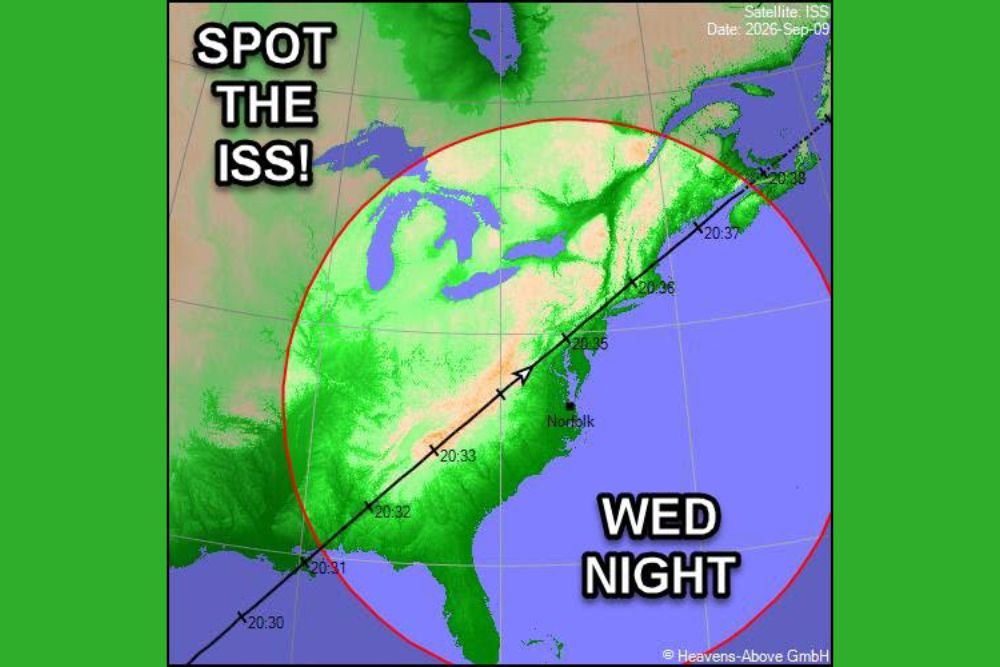
Tracking data for Wednesday night shows the station’s path sweeping diagonally across the eastern United States, moving from the Gulf Coast region northeastward through the Carolinas, up through Virginia near Norfolk, and continuing toward the Northeast and eventually out over the Atlantic Ocean near the Canadian Maritimes.
Wide Visibility Corridor Spans Multiple Regions
The visibility corridor for this pass extends across a broad swath of the country, encompassing the Ohio Valley, the Appalachian region, and the entire East Coast from the Southeast up through New England. Communities positioned along or near the path outlined in the tracking data, from the Gulf Coast through Virginia and up toward the Northeast, are positioned for some of the clearest and most direct overhead views of the station during this particular pass.
Even areas somewhat outside the direct path but within the broader viewing circle shown in the tracking data should still have a reasonable chance of spotting the station, since the ISS remains visible from a wide radius on either side of its direct overhead track given clear atmospheric conditions.
Seven Crew Members Currently Aboard the Station
As of this week, there are currently seven people living and working aboard the International Space Station, continuing the orbiting laboratory’s uninterrupted run of human habitation that has spanned more than two decades. The station serves as a continuously crewed platform for scientific research in microgravity, orbiting Earth roughly every 90 minutes at an altitude of approximately 250 miles.
Each pass like Wednesday night’s offers the public a direct, visible connection to that ongoing human presence in space, since the station itself is easily seen with the naked eye under the right conditions, requiring no telescope or specialized equipment to enjoy.
Best Practices for a Successful Viewing
Observers hoping to catch Wednesday night’s pass are encouraged to find a viewing location with a clear, unobstructed view of the southwestern sky and to begin watching a few minutes before the 8:30 PM start time, since the station will already be climbing above the horizon as the pass begins. Areas away from heavy light pollution will generally offer the clearest views, though the station is often bright enough to be seen even from within cities.
Given how quickly the station moves across the sky, typically completing a visible pass in five to six minutes, timing is important for anyone hoping to catch a glimpse or capture a photo or video of the event as it happens.
A Rare and Rewarding Skywatching Opportunity
Opportunities to see the International Space Station with clear, favorable timing across such a wide swath of the East Coast and Ohio Valley do not happen every night, making Wednesday’s pass a notable one for families and skywatchers throughout the region. The event offers a simple, accessible way for both adults and children to observe firsthand evidence of the ongoing human presence in low Earth orbit.
Anyone who successfully captures a photo or video of the pass is encouraged to document the moment, as sightings like this offer a memorable, real-time glimpse of the station and its crew as they orbit hundreds of miles above the planet.
For continuing coverage of severe weather events and critical storm analysis across the United States, visit svhsnow.com.