
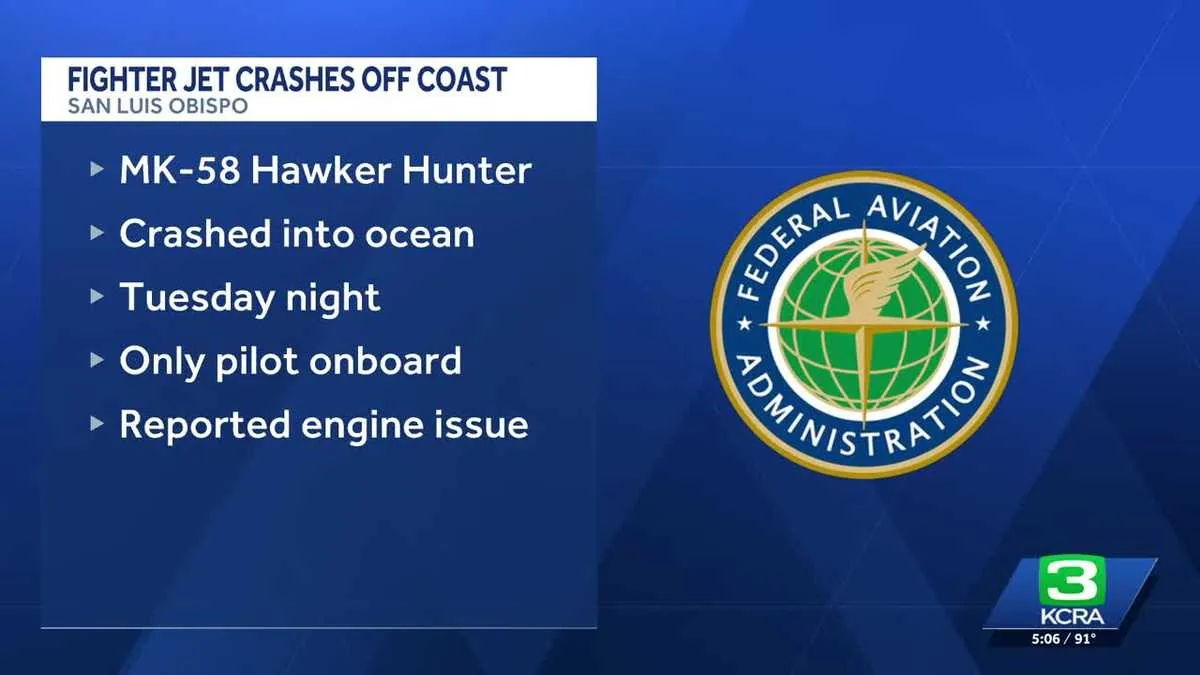
SAN LUIS OBISPO COUNTY, CA — A Hawker Hunter fighter jet crashed into the ocean near San Luis Obispo on Tuesday evening after the pilot reported an engine problem, according to federal investigators.
The aircraft, identified by the Federal Aviation Administration as an MK 58 Hawker Hunter, went down just before 7 p.m. near the Central Coast. The pilot was the only person on board.
Authorities have not said whether the pilot was hurt. The FAA said the plane was substantially damaged in the crash.
FAA says pilot reported engine issue before crash
Federal investigators said the pilot had reported trouble with the jet’s engine before the aircraft entered the water. That detail is now central to the early findings as officials work to determine what happened in the final moments of the flight.
The FAA’s preliminary report did not identify any additional occupants or other aircraft involved. With only one person aboard, investigators are focusing on the jet itself and the circumstances that led to the emergency.
No further information has been released about the flight path, the aircraft’s departure point, or whether the pilot attempted any other measures before the crash.
Substantial damage reported after the aircraft went down
The FAA said the jet was substantially damaged in the crash. That assessment indicates the impact was severe enough to leave the aircraft in a heavily damaged condition, even as investigators continue to collect basic facts.
MK 58 Hawker Hunters are military-style fighter jets, and the aircraft involved went down in ocean waters off the California coast. The preliminary report did not provide details about where in the ocean the wreckage ended up or how much of the plane remained recoverable.
Officials have not announced any findings about weather, visibility, or mechanical history that may have played a role.
Questions remain about the pilot’s condition
Authorities have not confirmed whether the pilot survived or was injured in the crash. That remains one of the biggest unanswered questions after the jet went down Tuesday evening.
Because the pilot was alone in the aircraft, there are no passenger accounts of what happened before impact. Investigators will likely rely on the aircraft’s condition, the pilot’s report of engine trouble, and any other available flight information.
So far, officials have kept the response limited to the basic facts that the FAA released in its preliminary report.
San Luis Obispo County crash adds to aviation concerns on the coast
The crash happened near San Luis Obispo, placing the incident along one of California’s better-traveled stretches of coastline. Incidents involving aircraft over water can be difficult to evaluate quickly because debris, weather, and visibility often complicate recovery work.
At this stage, investigators have not said whether the jet’s engine problem was connected to a maintenance issue, a mechanical failure, or some other cause. Those answers may take additional review.
For now, the case remains in its early stage, with the FAA handling the preliminary investigation and local officials providing limited information about the outcome.
What the preliminary federal report established
The FAA’s initial account establishes a few key facts: the jet was an MK 58 Hawker Hunter, it crashed into the ocean near San Luis Obispo just before 7 p.m. Tuesday, and the pilot had reported an engine issue before the impact.
It also confirms the aircraft carried only one person and suffered substantial damage. Beyond that, the early report leaves major details unresolved, including the pilot’s condition and the cause of the engine trouble.
Those unresolved questions mean the crash will likely remain under review as investigators gather more information from the scene and any available flight records.
Officials have not released a cause or injury update
As of the latest federal update, no cause has been announced and no injury confirmation has been provided. That leaves the public record limited to the circumstances around the crash itself and the FAA’s brief description of the aircraft.
The lack of a confirmed injury status underscores how much remains unknown in the immediate aftermath of the incident. Investigators have not said when additional details may be released.
For now, the crash is being treated as a developing aviation investigation with a small number of confirmed facts and many unanswered questions.
When the weather turns dangerous, SVH Snow is watching.