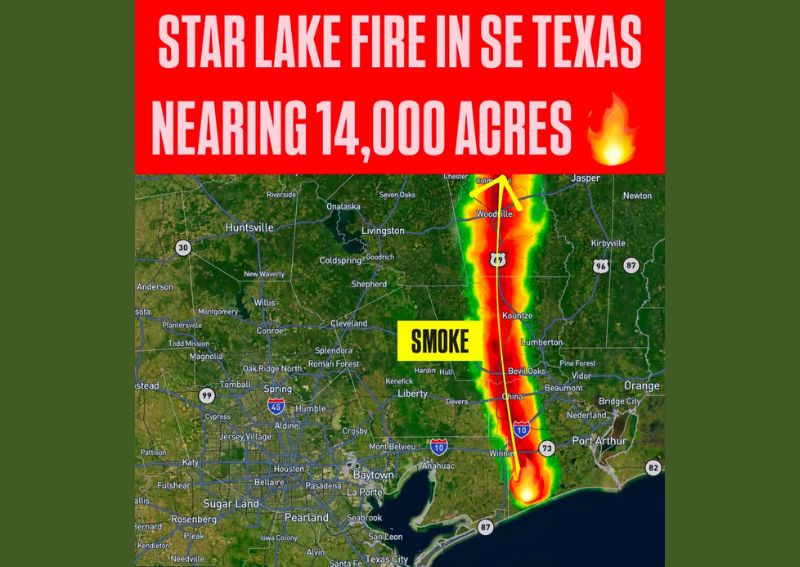
PORT ARTHUR, TX — Residents across southeast Texas are noticing significant smoke this morning from the Star Lake Fire, a wildfire burning southwest of Port Arthur that has grown to nearly 14,000 acres. The fire’s smoke plume has stretched dramatically northward, extending well beyond the immediate fire zone and affecting visibility and air quality across a wide swath of the region.
Smoke Plume Stretches Across a Wide Corridor
Radar and satellite imagery shows a dense, well-defined smoke plume tracking northward from the fire’s location southwest of Port Arthur, extending through communities including Winnie, China, Kountze, and Woodville before reaching as far north as Livingston and approaching Chester and Colmesneil. This extensive northward reach illustrates just how significant the smoke production has become as the fire continues burning across nearly 14,000 acres.
The plume’s path appears to closely follow the US Highway 69 corridor, with the most concentrated smoke, shown in deep red and orange coloring on the radar imagery, tracking directly along that route through the heart of the affected region.
Fire Burns Southwest of Port Arthur
The Star Lake Fire is burning in the marsh and coastal terrain southwest of Port Arthur, an area of southeast Texas known for its low-lying wetlands and grassland habitat. Fires burning in this type of marsh grassland terrain can spread quickly and produce substantial smoke, particularly when dry conditions and wind allow flames to move efficiently across the vegetation-rich landscape.
Given the fire’s coastal location near Beaumont, Port Arthur, and Orange, the significant acreage burned reflects the challenging nature of fighting fires in this type of marsh environment, where access for ground crews can be limited and fire behavior can be difficult to predict compared to more typical brush or forest fire settings.
Communities Across a Broad Area Affected by Smoke
The extensive reach of today’s smoke plume means residents across a significant portion of southeast Texas are likely noticing reduced visibility and the smell of smoke, even in communities located well north of the fire’s actual location. Areas including Beaumont, Lumberton, Silsbee, and Kountze all fall within or near the path of the thickest smoke concentration shown on today’s imagery.
This kind of widespread smoke impact from a single fire underscores how significant the Star Lake Fire has become, with its effects extending far beyond the immediate burn area to influence air quality and visibility across numerous communities throughout the region.
Air Quality Concerns for Affected Communities
With smoke stretching across such a wide geographic area, residents throughout the affected corridor, from the immediate fire zone near Port Arthur north through Livingston, should be mindful of potential air quality impacts, particularly those with respiratory sensitivities or underlying health conditions. Wildfire smoke can carry fine particulate matter capable of affecting air quality even at considerable distances from the actual fire.
Residents in communities directly beneath the thickest portion of the smoke plume, including those along the Highway 69 corridor, may experience the most significant reduction in visibility and air quality as the fire continues to burn and produce smoke throughout the day.
A Significant Wildfire for the Region
At nearly 14,000 acres, the Star Lake Fire represents a substantial wildfire incident for southeast Texas, an area that, while familiar with occasional brush and marsh fires, does not typically see fires of this scale as frequently as some other regions of the state. The fire’s size and the resulting extensive smoke plume have made it a notable topic of concern for residents across the broader region this morning.
Continued dry conditions and available wind can allow fires burning in marsh and grassland terrain like this one to continue growing, meaning residents should stay alert for updates on the fire’s progression and any changes to its containment status as firefighting efforts continue.
What Residents Should Expect
Residents across southeast Texas, particularly those in communities along the smoke plume’s path from Port Arthur north through Livingston, should expect continued reduced visibility and the presence of smoke throughout the day as the Star Lake Fire continues to burn. Those with respiratory concerns should consider limiting outdoor activity in areas experiencing the heaviest smoke concentration until conditions improve.
For continuing coverage of severe weather events and critical storm analysis across the United States, visit svhsnow.com.