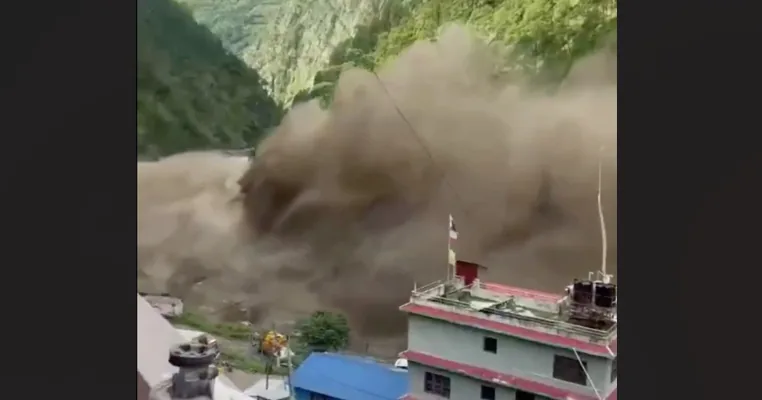
KATHMANDU, NP — Flash flooding in northern Nepal has killed at least 162 people and left 403 more missing, including 33 Americans, after a sudden surge of water ripped through border communities on Wednesday.
Authorities say the disaster hit the Bhote Koshi River area in Rasuwa district and spread into nearby Nuwakot and Dhading. The flooding destroyed homes, bridges, roads and power facilities, while rescue crews faced steep terrain, washed-out access routes and damaged infrastructure.
U.S. officials later said the flooding was triggered by a glacial collapse, not an earthquake. Helicopter teams have managed to reach some isolated areas, but many communities remain cut off as emergency workers search for survivors and assess the scale of the damage.
Missing Foreign Tourists and Rescue Challenges
Nepal’s Tourism Board said 341 foreigners were missing after the flood, based on information from tour companies. Among them were travelers from the United States, Australia, Canada, Germany, Malaysia and Israel, according to board chief Hikmat Singh Ayer.
Ayer told CBS News that 403 people overall were unaccounted for in Nepal after the flooding. The missing tourists were largely on organized trips, which has made it harder for families and officials to track who was in the region when the water hit.
David Fisher, head of the International Red Cross delegation in Nepal, said many places remain inaccessible and that ground teams are struggling to move through the disaster zone. He said entire villages and markets have disappeared, and that the damaged route between China and Nepal is a major blow to local commerce.
Reuters reported that helicopters could not land in some affected areas, including Syapru Besi and Timure, underscoring how difficult the search effort remains. Officials have also warned residents living near the river to move to higher ground.
What Officials Say Happened
Nepal’s foreign minister initially said the flood followed an earthquake that caused a landslide and blocked the river. The U.S. Geological Survey later rejected that account after reviewing seismic data and satellite imagery.
The USGS said the event was instead caused by a glacial collapse and debris flow, and that no earthquake occurred. The agency said the flood had first been reported as a magnitude 4.4 quake before further analysis showed otherwise.
Chinese state media reported severe damage on the Tibet side of the border as well, including casualties from a mudslide at a border hub. State broadcaster CCTV later said hundreds were missing there too, with many of them foreigners, according to The Associated Press.
The Nepal Electricity Authority said six major hydropower and transmission facilities were damaged. Nepali leaders urged a rapid rescue response, and U.S. Secretary of State Marco Rubio said Washington stood ready to help with humanitarian assistance.
U.S. Response and Wider Impact
The State Department said it will provide $500,000 through a global award with Catholic Relief Services to support emergency shelter, relief supplies, and water, sanitation and hygiene assistance for flood-hit communities.
The department said the U.S. Embassy in Kathmandu is working with local authorities to locate and help Americans affected by the disaster. That effort comes as the region continues to face dangerous conditions and uncertain access to some of the hardest-hit riverbanks and mountain settlements.
Nepal’s president said he was deeply saddened by the loss of life and property and called for stronger rescue and relief efforts. District officials also warned that there could be heavy casualties and additional damage as teams continue to move through the flood zone.
India said it has ordered border-state authorities to stay on high alert as the disaster unfolds in the Himalayan region.
When the weather turns dangerous, SVH Snow is watching.