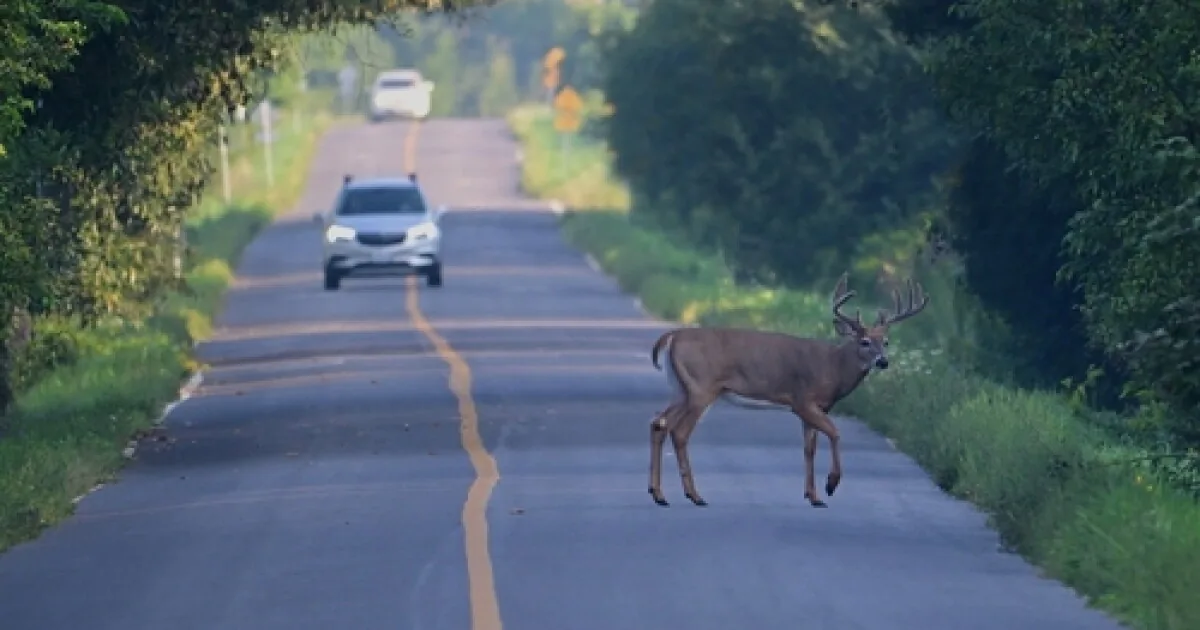
FRANKFORT, KY — Kentucky officials are asking drivers to be especially cautious this fall after the state recorded 3,411 deer collisions in 2025, the most in seven years. The increase continued a steady climb that has been building since 2020.
State highway officials said the seasonal spike in deer activity makes October through December a particularly dangerous stretch on roads across the commonwealth. They are urging motorists to slow down, stay focused and wear seat belts, especially at dawn, dusk and during evening commutes.
Deer movement peaks as mating season begins
The Kentucky Department of Fish and Wildlife Resources said deer become more active in the fall as mating season starts and animals travel farther in search of food and mates. That movement raises the chances of deer crossing roadways in both rural and busy areas.
Joe McDermott, the agency’s deer program coordinator, said drivers may encounter deer on quiet lanes and heavily traveled highways alike. He said the risk is highest during dawn and dusk, when visibility is lower and deer are more likely to be moving.
State Highway Engineer James Ballinger said motorists should stay alert in areas where deer are present and treat the season as a time for extra caution. He said a few additional moments of care can help prevent a serious crash.
November produced the biggest share of collisions
Crash data show that nearly half of Kentucky’s deer collisions last year happened during the final three months of the year. November led all months with 823 reported crashes, followed by October with 394 and December with 330.
Together, those three months accounted for nearly 46% of the state’s deer crashes in 2025. Officials said that pattern matches the time of year when deer movement is strongest and daylight is shorter.
The numbers also showed that crashes are most common in low-light conditions. The highest totals came between 6 p.m. and 8 p.m., when many drivers are heading home from work.
No deer-crash deaths were reported in 2025
Even as the number of collisions rose, Kentucky saw an improvement in the deadliest outcomes tied to deer crashes. No fatalities were reported in 2025, compared with six deaths in 2024.
Thirty people suffered serious injuries last year in deer-related collisions. Officials did not release additional details about those crashes, but they said the figures underscore why drivers should remain attentive during peak deer season.
The Kentucky Transportation Cabinet said drivers should reduce distractions, use headlights appropriately and avoid swerving if a deer enters the road. Instead, officials advise braking firmly while maintaining control of the vehicle.
Hopkins County reported the most crashes in the state
Deer collisions were not spread evenly across Kentucky. Hopkins County recorded the most in 2025 with 134 crashes, followed by Hardin County with 118.
Muhlenberg County and Nelson County each reported 95 crashes, while Boone County had 94, rounding out the five counties with the highest totals. Officials use that local crash data to help identify where warning signs or other safety measures may be needed.
Drivers involved in a deer-related crash are encouraged to report the incident to law enforcement so agencies can track problem areas and consider future steps to improve safety.
State and federal projects aim to reduce wildlife crashes
Kentucky is also working on longer-term efforts to limit wildlife-related collisions. The state received a $1.2 million federal grant in 2024 to develop a wildlife-vehicle collision reduction plan and study several stretches of road in central Kentucky.
That research focuses on portions of Interstate 64 and U.S. 60, where transportation officials are examining deer movement and habitat patterns. The goal is to find infrastructure improvements that could make roads safer for both drivers and wildlife.
State officials said the work will help shape future decisions on where to place safety measures. For now, they are emphasizing the basics: pay attention, slow down near wooded areas and stay especially alert at dawn and dusk.
When the weather turns dangerous, SVH Snow is watching.